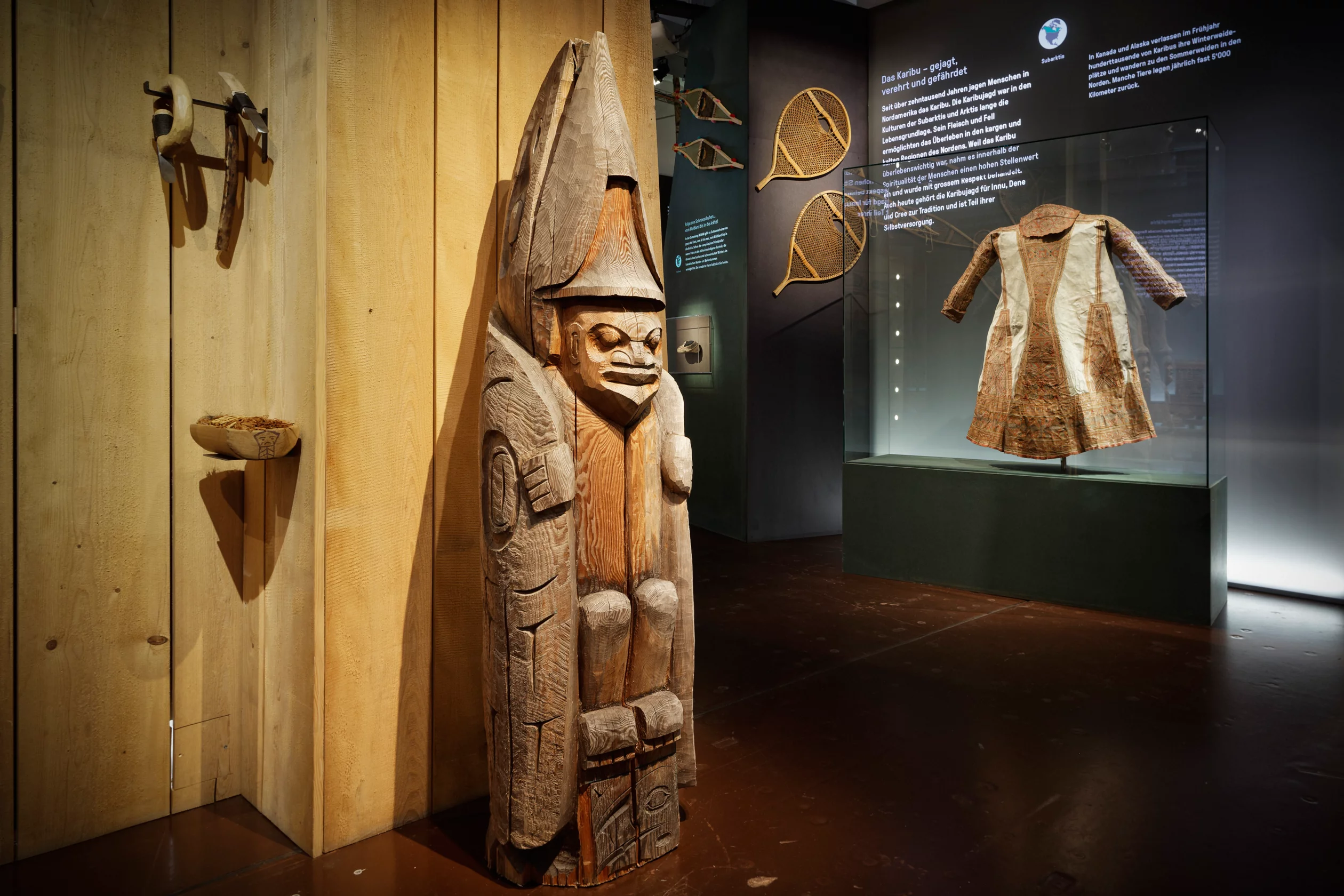
Indigenous artists in urban settings, whalers in the Arctic, bison hunters on the Great Plains or mask carvers on the Northwest Coast. NONAM invites you on a little journey across the vast North America. The exhibition highlights the diversity of the Indigenous Nations and offers insights into the art and cultures of First Nations, Inuit, Native Americans and Native Alaskans.
In the museum's «soundscape» installation, the north wind sweeps across the tundra, mysterious calls echo across the Pacific, children sing, artists carve their wooden masks, the echo of a drum reverberates through the Canyon de Chelly. Using just their ears, visitors can explore the world of the Inuit, Kwakwaka'wakw (Kwakiutl), Hopi and Diné (Navajo).
Indigenous Nations originally did not use written languages. The reception and transmission of information was essentially based on acoustic communication and oral transmission. Hearing was often essential for survival, because hearing does not fail in the dark or during sleep. Today, we transmit countless data electronically and without the need to listen. In doing so, we seem to forget how much information we absorb unconsciously and unprocessed through our hearing.
Contemporary Indigenous art is characterized by the people behind the works and their biography – that is why many Indigenous artists see themselves as modern storytellers. Multimedia artist Dylan McLaughlin (Navajo) introduces the artists represented in the exhibition. His video portraits were created as part of the special exhibition "Native Art Now" (2014).
We would like to thank the Lottery Fund of the Canton of Zurich for supporting the purchase of art and video production.
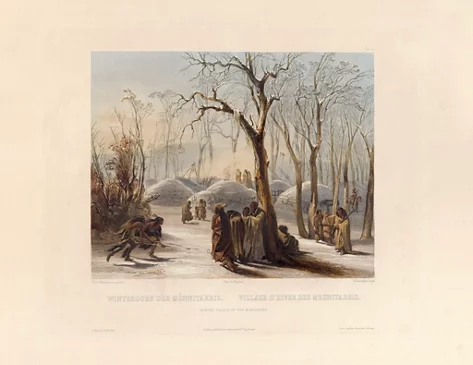
In 1832-34, Prince Maximilian zu Wied-Neuwied travelled North America by steamship, accompanied by the hunter Dreidoppel and the young painter Karl Bodmer from Zurich. While the prince documented, measured, described and classified, Karl Bodmer made sketches and watercolors to illustrate Maximilian's notes. Bodmer's engravings, which were produced after his return home, are now world renowned. The prince's travelogue, on the other hand, is relatively unknown.
In the Bodmer Gallery, a small selection of copper engravings from the work «Journey to Inner North America in the Years 1832 to 1834» can be seen. For conservation reasons, the hand-coloured illustrations are regularly replaced.
In comfortable listening chairs, excerpts of some of the prince's depictions of his travel experiences and the encounters with the Indigenous population in the 19th century can be listened to.