
New Special Exhibition Starting November 29
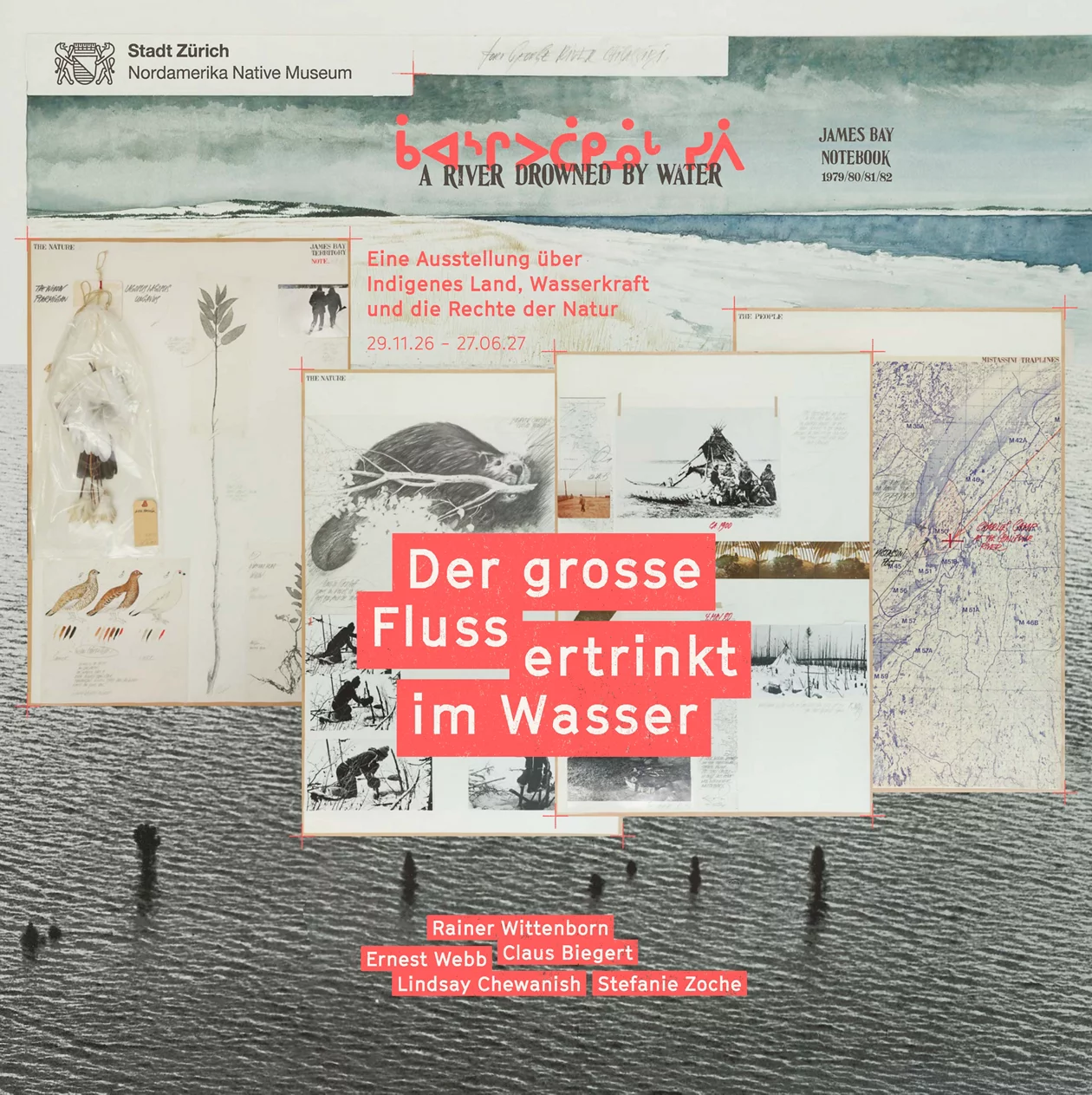
The exhibition explores the tension between hydropower, Indigenous rights, and the rights of nature. Its starting point is the James Bay Notebook, a collaborative work by artist Rainer Wittenborn and journalist Claus Biegert. The artistic exploration focuses on the largest hydropower project of its time—the James Bay Hydroelectric Project in the province of Quebec—and its impact on the James Bay Cree. Built in the 1970s, the project flooded Indigenous lands, with far-reaching consequences for the Cree way of life. Hydropower is considered green energy. But what price do the affected communities pay for it? What about Indigenous rights? And should rivers also be granted rights? The exhibition gets your thoughts flowing and invites you to delve into in-depth water-related topics.
In cooperation with journalist Claus Biegert, Cree filmmaker and film producer Ernest Webb, Cree artist Linda Chewanish, and artist Stefanie Zoche. The James Bay Notebook is on view for the last time in Europe at NONAM. Afterward, it will return to Chisasibi, where its journey began in 1981—it will be added to the collection of the Cree Culture and Heritage Centre.
Claus Biegert
Since the 1970s, journalist, author, and documentary filmmaker Claus Biegert has been reporting on Indigenous peoples in North America. His work focuses on land rights, cultural self-determination, and the consequences of uranium mining and the nuclear industry for Indigenous communities and around the world. He is the initiator of the World Uranium Hearing (1992, Salzburg, Austria), co-founder of the Nuclear-Free Future Award (1998), and co-editor of the Uranium Atlas. Biegert worked for Bayerischer Rundfunk and taught at the German School of Journalism in Munich. He received the Leopold Kohr Honorary Prize for his work and was honored for his life’s work at the International Uranium Film Festival in 2024. He is currently working closely with Māori from New Zealand to advocate for the rights of rivers and waterways in his home state of Bavaria and internationally.
Rainer Wittenborn
Rainer Wittenborn is a painter, graphic artist, and professor emeritus of art at the Technical University of Munich. After studying at the Academy of Fine Arts in Munich, he received the New York Scholarship from the German Academic Scholarship Foundation, the Villa Massimo scholarship in Rome, as well as the Bavarian Promotion Prize and the Fritz Winter Prize. His work spans drawing, printmaking, and artistic research. He gained international recognition through projects focusing on landscape, the environment, and Indigenous ways of life. These include the “James Bay Project,” begun in 1979, which explored the Cree people of Quebec and which he documented in collaboration with Claus Biegert. The project was exhibited, among other venues, at the San Francisco Museum of Modern Art (SFMOMA) in 1981 and at the São Paulo Biennial in 1983. Rainer Wittenborn lives in Munich.
Ernest Webb
Ernest Webb is a filmmaker and film producer, as well as a co-founder of the newspaper *The Nation*, which serves the Eeyou Istchee Autonomous Region. Webb combines artistic work with cultural self-determination and Indigenous representation. In his works, he repeatedly explores the James Bay region, the James Bay hydroelectric project, and the James Bay and Northern Quebec Agreement. In 2001, Ernest Webb co-founded Rezolution Pictures with Catherine Bainbridge. The award-winning production company enriches the Indigenous media landscape with documentaries and series that shed light on Cree culture, language, history, and contemporary life with great intimacy and respect. *Reel Injun* and *Rumble: The Indians Who Rocked the World* were also broadcast in Germany and Switzerland. In *Cree Spoken Here* and *Down the Mighty River*, he explores themes and challenges in his homeland, James Bay.
Lindsay Chewanish
Lindsay Chewanish is an Eeyou (Cree) artist from Chisasibi in Eeyou Istchee, in northern Quebec. After spending most of her childhood in southern Quebec, she returned to her homeland about eight years ago. This experience shapes her artistic practice, which blends cultural roots, everyday life in the North, landscapes, and character-driven narratives. Chewanish works with both brushes and paint as well as digitally, developing a semi-realistic style. In her short film *Nuuhkuum uumichiwaapim* (“My Grandmother’s Tipi,” 2025), she brings to life memories of life in a tipi, family closeness, and the passage of time.
Stefanie Zoche
Visual artist Stefanie Zoche studied art in Perpignan, France, and London, UK. From 1998 to 2014, she collaborated with Sabine Haubitz as an artist duo. In her installations and video works, she explores the fragile relationship between humans and the non-human world. Her work focuses on the climate crisis and the use of resources such as sand and water. Since 2025, she has been advocating for the rights of rivers and, together with Claus Biegert, is a co-founder of the Loisach Alliance. Her works have been exhibited internationally (including the Havana Biennial, the Pinakothek der Moderne in Munich, the Centre Georges Pompidou in Paris, the Eres Foundation in Munich, the Nikolaj Kunsthal in Copenhagen, the Architekturzentrum Wien, and the Haus der Kunst in Munich).
Every Sunday, our media room turns into a mini-movie theater. At 1:00 p.m., we’ll be showing the documentary “James Bay 1975: The Shock of Two Nations,” and at 3:00 p.m., the nature film “River.” Admission to the museum includes these films.