
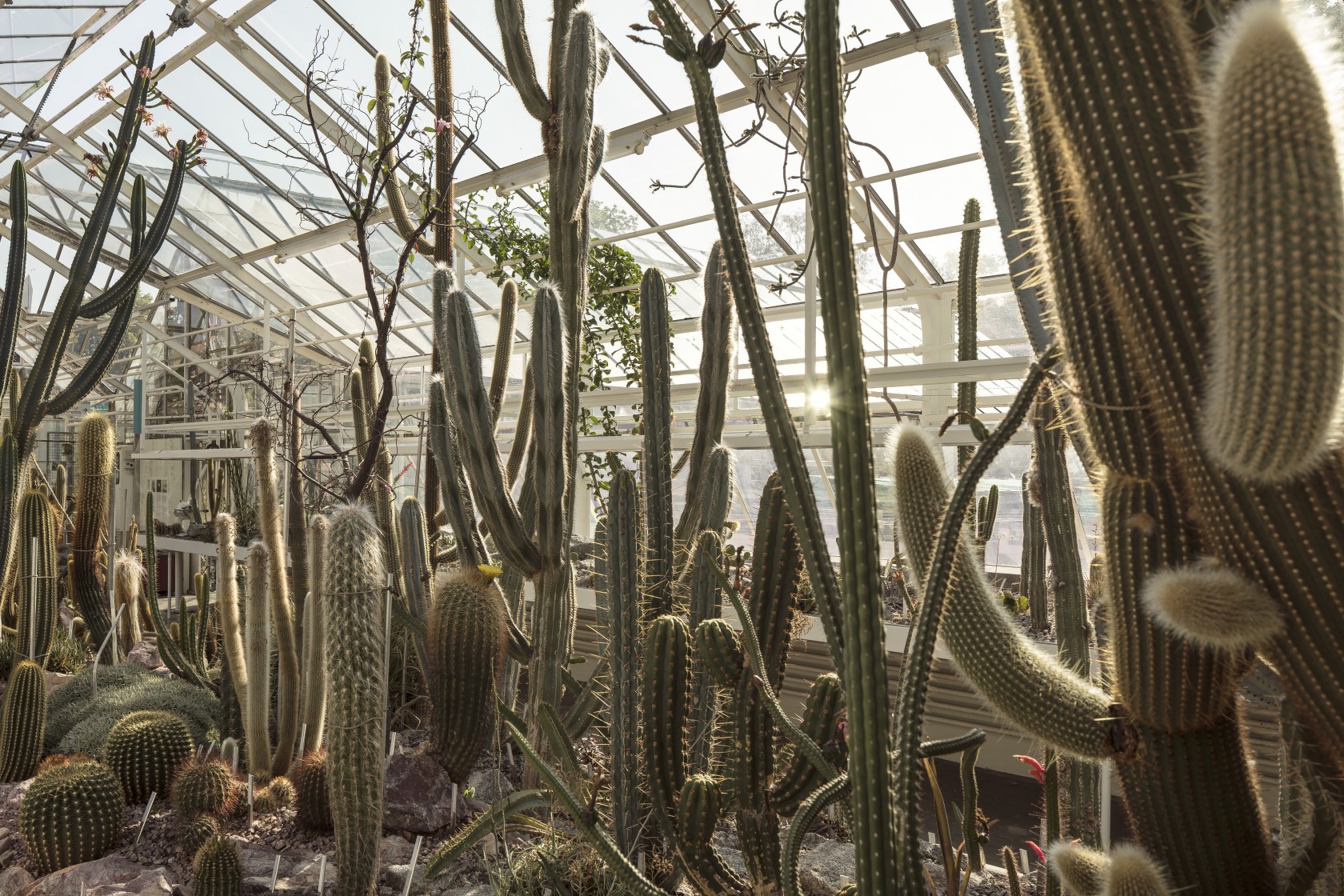
The Zurich Succulent Collection focuses its collections, cultivates conservation cultures and participates in the international seed exchange between botanical gardens worldwide. The origin of the plant populations is precisely documented.
The live collection in the display areas and in the background greenhouses shows a representative cross-section of the systematic groups, distribution areas and habitats of the succulent plants of our planet.
To this end, the greenhouses basically follow a geographical order. An attempt is made to recreate the habitats of these plants. Exceptions are the large plant house, the epiphyte house and the wooden succulent house. These three houses show plants from different habitats, which, for example, can be used to vividly convey ecological or evolutionary relationships.
In the more than 90-year history of the collection, a number of focal points have stood out, most of which have been spurred on by the cultivation of the international network of botanical gardens, collectors and enthusiasts. Originally, the succulent collection was called the "Municipal Cactus Collection" and consisted mainly of cacti plants.
Today, plants from the arid regions of South America, South Africa and Madagascar are particularly abundantly represented in the succulent collection. Walter Röösli and Ralph Hoffmann's collection of Malagasy plants is located in the city nursery in Zurich-Albisrieden due to limited space. It is housed in the Subtropical House, which opened in 2014 as a branch of the Zurich Succulent Collection.
In times of climate crisis and biodiversity loss, natural history collections such as the succulent collection are of particular importance. The live collection not only provides the basis for research and educational activities, but is also a conservation culture for rare and endangered species as well as their genetic diversity. In addition, the plants can be integrated into species conservation projects.
Propagation to maintain live collection is primarily based on generative propagation through controlled pollination.
The succulent collection participates in the international seed exchange. Seed exchange is an important part of species conservation in the ex-situ cultures of botanical gardens. At the succulent collection, the plants are checked and pollinated to the exclusion of insects.
Towards the end of each year, we publish the current seed catalogue (Index Seminum).